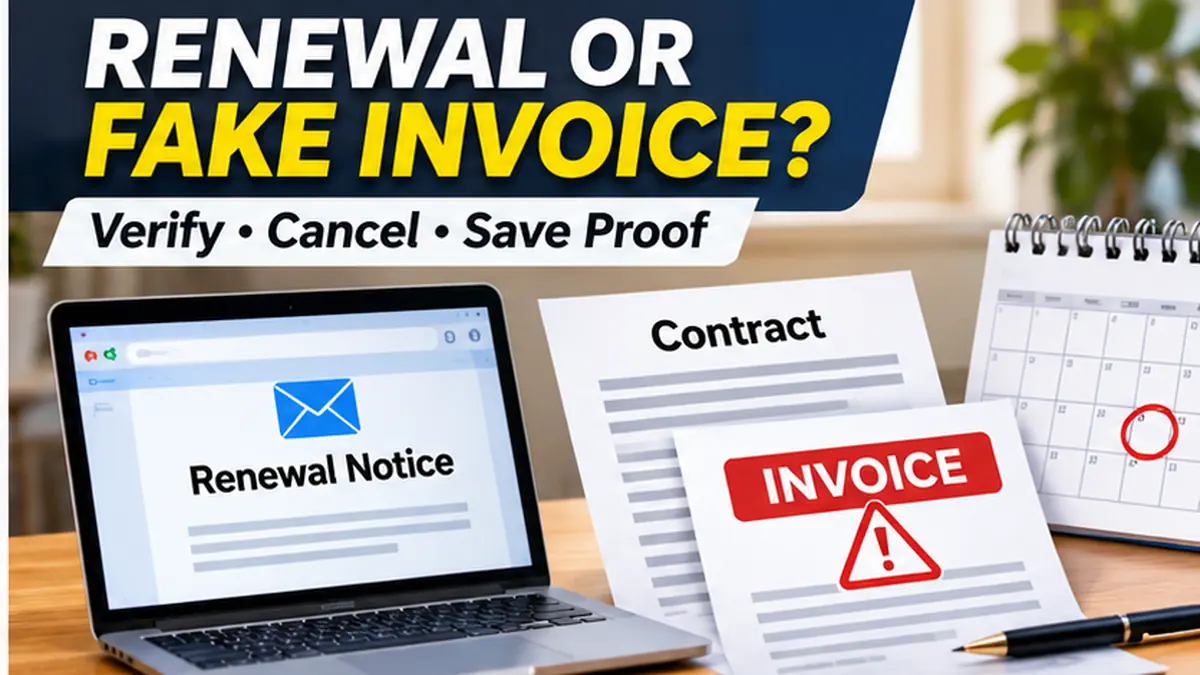
Quick answer: A renewal email is not itself proof that you owe money, and a subscription cancellation confirmation is not proof that all future charges have stopped. For a U.S. household, separate three questions: Do I have an active agreement? What amount and date did I authorize? Did my cancellation actually become effective? Verify the provider through a known account or prior statement—not a payment button or phone number inside an unexpected message.
Method and limits: FTC consumer guidance reviewed November 12, 2026, cross-checked against a reproducible billing ledger below. This is editorial analysis of published guidance, not a live bank-account test, company investigation, chargeback outcome or legal advice. Contract terms and state rules vary.
Three documents, three different types of proof
| Document or screen | What it may show | What it cannot prove alone | Reader action |
|---|---|---|---|
| Renewal email | A claimed plan, amount and date | That the sender is genuine or you agreed | Open the provider using a previously saved official URL |
| Original order or service agreement | Plan, trial term, renewal consent and cancellation route | That an account remains active today | Compare with provider dashboard and recent statements |
| Cancellation request or confirmation | When and how you requested to stop | That no future charge will post or a refund is due | Save confirmation, effective date and next statement |
Reconstruct the price change with a receipt-to-renewal ledger
For each line, write the document date, price and evidence source. In this illustrative example, the first three months are $5 each, then nine months are $19 each. 3 × $5 + 9 × $19 = $186 in planned first-year payments, ignoring taxes and additional fees. This is arithmetic only, not a real subscription quote. A notice promising “save $168” cannot be validated until you know the actual rate, commitment length and any cancellation charges.
| Illustrative item | Amount | Evidence required |
|---|---|---|
| Promotional months 1–3 | 3 × $5 = $15 | Signup receipt and discount duration |
| Standard months 4–12 | 9 × $19 = $171 | Provider's stated renewal price |
| Illustrative 12-month total | $186 | A written plan that matches actual dates |
| Message claims $0 to renew | Do not assume $0 | Check whether setup fee, new tier or future billing exists |
A five-minute sender-and-charge verification sequence
- 1. Do not click a surprise payment link. Check the account from a known app or official provider website; a fake renewal notice can imitate a genuine company.
- 2. Locate your evidence. Find the original order date, authorized rate, trial end and most recent statement without uploading bank credentials to an AI tool.
- 3. Compare the correct event. A renewal reminder is not the same as an invoice, successful charge or cancellation deadline.
- 4. Stop unwanted future billing through the provider. Use its documented cancellation workflow; record the date, effective time and resulting confirmation.
- 5. Verify the next statement. If charges continue after cancellation or you see an unauthorized charge, contact your card issuer promptly using a trusted channel about the dispute procedure.
The critical difference between 'requested cancellation' and 'no further charges'
A saved email that says “we received your request” may not state that service ends immediately. Ask: Does access continue until the paid period ends? Is an installment balance still owed? Does the contract impose an early-exit condition? A consumer who disputes a legitimate charge without checking these facts may not resolve the underlying agreement. Where permission or refund eligibility is contested, preserve timestamps and written terms and seek appropriate consumer help.
| Situation | Do not assume | Practical evidence |
|---|---|---|
| No account found at the company | The email is necessarily genuine | Check bank records, old signup correspondence and company identity |
| Cancellation received, but service remains active | Future charges are stopped | Effective date, provider reply, future bill |
| Charge after cancellation | Automatically refundable in every case | Cancellation proof, posted transaction date, issuer dispute details |
| Request to enter card details to avoid losing account | The demand is legitimate | Navigate independently; do not use the message's link |
Two hypothetical renewal-notice cases
These are fictional examples, not reports of actual customers or verified account activity.
Case A — a renewal matches a known subscription: An email claims a $19 monthly renewal, and the same merchant and amount appear in the household’s usual account history. Do not use the email’s payment link. Sign in through the provider’s known app or address, compare the original plan and current renewal terms, then save the provider’s cancellation-effective date and the next statement. A matching amount still does not prove the email itself is genuine.
Case B — an unexpected $249 invoice: The household does not recognize the merchant and sees no matching transaction in the account checked. Do not click, pay, or enter card details from the message. Independently verify the provider and check other relevant payment records; absence from one statement alone does not prove the notice is fraudulent. If the provider confirms no account or charge, retain that response; if a real charge appears, use the appropriate provider or card dispute channel.
Official sources and independently added decision structure
The FTC guide to trials and auto-renewals warns about fake renewal notices, price changes and keeping cancellation records. The FTC's unauthorized subscription guidance addresses documenting requests and disputing inappropriate charges. Our three-document proof matrix and arithmetic worksheet organize those recommendations into a reproducible household procedure; they are not a regulator-approved dispute determination.
Next action: Save the original agreement, the claimed renewal notice and any cancellation confirmation side by side. Redact account numbers and personal details before using any comparison software. For a broader recurring-charge inventory, see our subscription cost audit, or check a distinct contract category in the recurring-bill guide library. Send corrections.